Disclosure: arvrguide.com may earn a commission if you buy through links on this page, at no extra cost to you. We only recommend gear we’d buy with our own money.
Every XREAL model, one list
All six pairs and the companion unit, each with its Amazon buy link. Prices shown are XREAL’s list prices; Amazon prices move around, so tap through for today’s price.
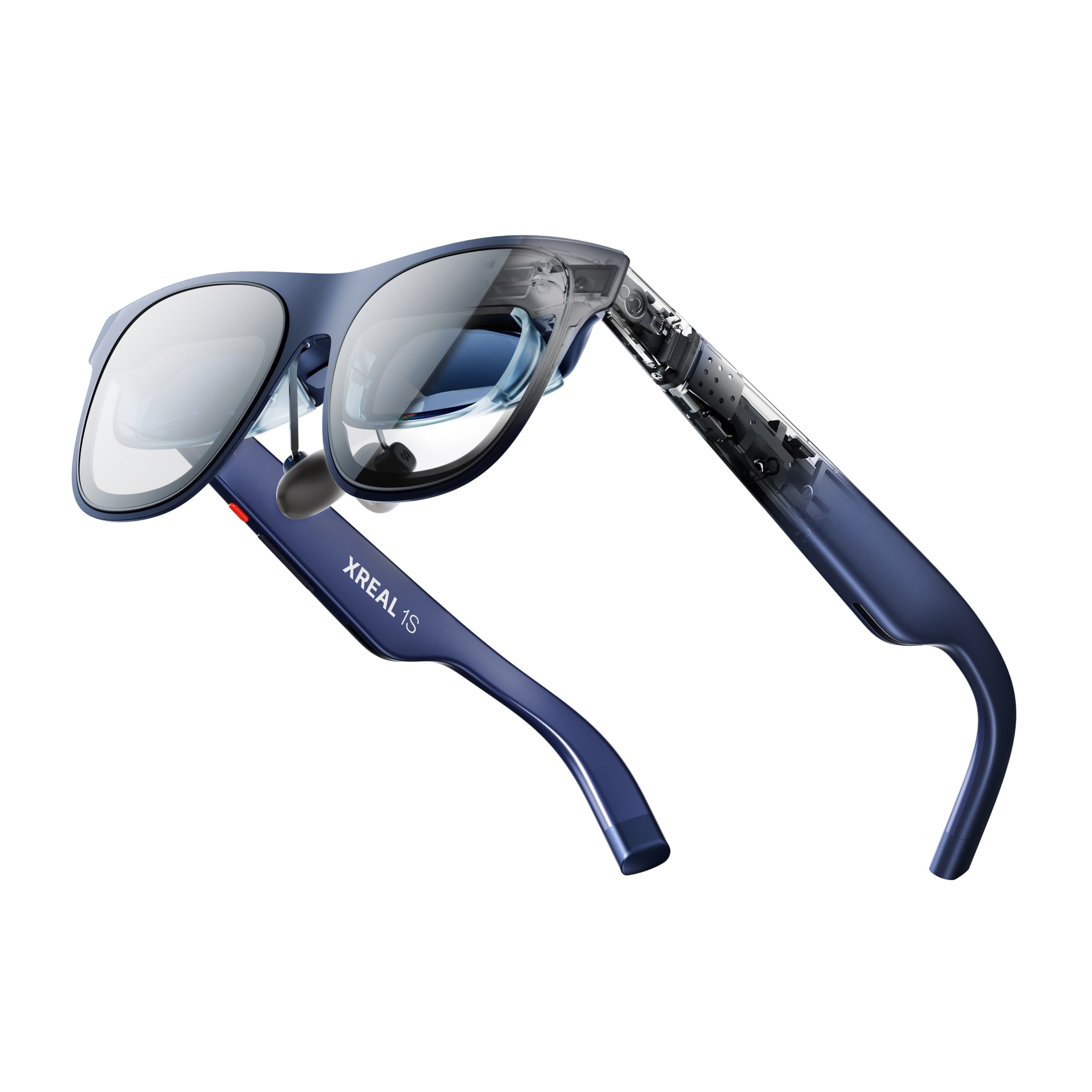
XREAL calls the XREAL 1S “escape that fits in your pocket,” and for once the marketing line is honest. This is a pair of sunglasses with a 1,200p screen hidden in each lens, it plugs into whatever you already own, and it costs $449. No battery, no case the size of a bread loaf, no app you have to babysit. Pull it out of your pocket, plug in, and there is a big private screen hanging in the air.
What the 1S actually is
The 1S is the newest rung in XREAL’s One series, released in January 2026 after CES. It runs the same X1 spatial computing chip as the flagship XREAL One Pro, at the same 120Hz, with the same Bose-tuned open-ear audio. What it trades away is field of view: 52 degrees against the One Pro’s 57. What it gains is resolution: 1,200 pixels per eye against the One Pro’s 1,080.
Read that again, because it is the whole review in two sentences. The cheaper pair has the sharper screen. The expensive pair has the wider view.
The sharper-screen advantage in practice
On paper a 200-pixel bump per eye sounds modest. Through the lenses it is the difference between text that looks like text and text that looks like it was screenshotted twice. Subtitles, browser pages, code, chat windows: the 1S holds them cleaner. Long-term wearers settled on scaling the display up for comfort and still call reading solid for one to two hour stretches.
Where the 1S does not win is scale. Movies feel slightly smaller than on the One Pro, and desktop ultrawide work is where the One Pro’s extra field of view earns its $150. If your main use is a virtual cinema on a plane or a personal monitor on the couch, the 1S is the right tool. If your main use is replacing a multi-monitor desk setup, read our One Pro review before deciding.
Plugging it into everything
The 1S is a plug-in display: USB-C into a phone, a laptop, a Steam Deck, a Switch-class handheld, and you get the screen. It draws power and video from whatever it is plugged into, so there is nothing to charge on the glasses themselves. The X1 chip handles the spatial layer on board: Native 3DoF keeps the screen anchored as you move your head, and Real 3D converts 2D video into side-by-side 3D without extra apps.
One honest note for buyers comparing every AR glasses option: there is no camera, no assistant, no apps. This is not a Ray-Ban Meta competitor and does not pretend to be. It is the best portable screen you can fold and put in a jacket pocket, and our smart glasses category separates this kind of display glasses from camera-first AI glasses for exactly that reason.
Comfort
At 82 grams with a flexible sunglasses-style frame and silicone nose pads, the 1S is the lightest XREAL you can buy new right now. It disappears on your face the way normal sunglasses do, which matters more than any spec when the session runs two hours. The display focal distance sits around five meters, so most nearsighted users can watch comfortably without inserts, and XREAL’s prescription lenses run $49.90 to $149.90 if you want correction built into the glasses.
The comparison everyone asks about
Viture’s Pro XR is the 1S’s closest rival at this price, and it is a genuinely good pair. The 1S counters with the X1 chip’s on-board spatial layer and Bose audio. If you are cross-shopping both, the deciding factor is usually which virtual screen positioning you prefer, and that is a try-it question, not a spec-sheet question.
As for XREAL’s own older brother, the original XREAL One: it still gets searched, but the 1S is effectively its replacement at the same price point, with the sharper panels.
Who should buy the 1S
You travel, you rent, or your TV is in the room where the baby sleeps. You want a big personal screen for movies, gaming on a handheld, or working from a laptop without a monitor. You want the sharpest picture per dollar in XREAL’s current line.
Who should skip it
You need the widest possible virtual monitor for desk work: the One Pro. You want cameras, an assistant, and an always-available AI: that is a different product category, and the honest answer is you are shopping for Meta or one of the Android XR pairs coming this year, not the 1S.
Price and where to buy
The 1S ships free over $100 direct from XREAL with a 30-day return window and a one-year warranty.
FAQ
Is the XREAL 1S better than the XREAL One Pro?
For video and reading, most buyers will prefer the 1S: sharper panels, $150 less. The One Pro wins only when you need its wider 57-degree field of view for work or scale.
Does the XREAL 1S have a battery?
No. It plugs into your phone, laptop, or handheld over USB-C and draws power from the host device.
Is the XREAL 1S one of the best smart glasses 2026 has to offer?
In the display-glasses half of the market, yes, it is the value pick. Best smart glasses 2026 lists that include camera-first AI glasses are ranking a different category.
Can the XREAL 1S run apps?
No. The X1 chip handles display anchoring and 3D conversion on board, but apps require the Beam Pro companion or an Android XR pair like the XREAL AURA.
More in this topic: XREAL One Pro Review: $599 AR Glasses Worth It?, XREAL One Review (2026): The 3DoF AR Glasses Worth $399